
Low Vision Care for Diabetic Retinopathy
The insurance letter looks like a gray smudge. The recipe card you have used for 30 years is suddenly hard to follow. When diabetic retinopathy starts to affect your sight, it usually does so quietly, in small tasks you once did without thinking.
Low vision care does not repair retinal damage or replace the treatment your eye doctor or retinal specialist provides. What it can do is help you use the sight you still have for the things you want to keep doing, and show you which aids make those tasks easier.
What Is Diabetic Retinopathy?
Diabetic retinopathy is damage to the light-sensitive tissue at the back of the eye. The retina turns light into signals your brain reads as images, and it depends on a fine network of blood vessels to do that work.
Years of high blood sugar can weaken those vessels. Some leak fluid or blood into the retina. Others narrow and close off, so parts of the retina lose the oxygen and nutrients they need.
The longer you have had diabetes, and the higher your blood sugar runs, the more likely retinopathy becomes. That is why screening matters even in years when your vision feels fine.

How Diabetic Retinopathy Progresses
Eye doctors describe diabetic retinopathy in two stages. Knowing which stage you are in helps your care team decide how closely to watch your eyes.
Nonproliferative Diabetic Retinopathy
In this earlier stage, weakened vessels leak fluid or blood into the retina. It can be mild, moderate, or severe, and it often causes no symptoms at first. When fluid collects in the macula, the small area that handles fine detail, straight-ahead vision blurs.
Proliferative Diabetic Retinopathy
In this advanced stage, the retina grows new blood vessels in response to reduced blood supply. These vessels are fragile and can bleed into the eye. Scar tissue can also pull on the retina, which may cause a retinal detachment and rapid, serious vision loss.
Symptoms of Diabetic Retinopathy
Early retinopathy usually causes no symptoms, which is why a dilated exam is the only reliable way to catch it. When changes do reach your vision, you might notice:
- Blurred or fluctuating vision that changes from one day to the next
- Dark spots, strings, or floaters drifting through your view
- Trouble reading small print, even with your usual glasses
- Colors that look washed out or less vivid than they used to
- Areas of your vision that seem blank or darker than the rest
- Weaker vision in low light or at night
When to Seek Immediate Eye Care
Some changes are emergencies rather than reasons to wait for your next appointment. Get urgent eye care the same day for sudden vision loss, a shower of new floaters, flashes of light, or a dark curtain spreading across your vision. These can mean bleeding inside the eye or a detached retina, and fast treatment saves more sight.
Other Eye Problems Linked to Diabetes
Diabetes affects more of the eye than the retina. These problems can appear alongside retinopathy or on their own, and the exam that checks for one also looks for the rest.
- Diabetic macular edema: fluid that collects in the macula and blurs or distorts the center of your vision.
- Cataracts: clouding of the eye’s lens. Diabetes raises the risk and can bring cataracts on earlier. Read about cataracts and low vision.
- Glaucoma: damage to the optic nerve, usually from pressure inside the eye. Diabetes raises the risk of some forms. Learn about glaucoma care.
- Vitreous hemorrhage: bleeding into the clear gel that fills the eye, which can fill your view with floaters or block it almost completely.
Diabetes is only one route to low vision. Our practice also works with patients living with macular degeneration, inherited retinal conditions such as Stargardt disease and retinitis pigmentosa, and sight lost after a stroke. If you are not sure where your own diagnosis fits, the low vision ocular diseases overview is a good place to start.
Why Annual Dilated Eye Exams Matter
Diabetic eye disease develops quietly, often without pain or any change you can name. A dilated exam lets your eye doctor see the retina directly, look for leaking vessels and swelling, and begin treatment before more vision is lost.
Most people with diabetes need a dilated eye exam at least once a year. Your doctor may suggest a closer schedule if retinopathy is already present, if your blood sugar control is changing, or during pregnancy with preexisting diabetes.
Keeping blood sugar, blood pressure, and cholesterol near your target range with your health care team is the other half of the work. Those numbers influence how fast retinopathy moves and how much vision you keep.
Low Vision Aids That Make Daily Tasks Easier
If treatment is underway, your prescription is current, and daily tasks are still hard, a low vision evaluation can show you what else is possible. Low vision aids work with the sight you have. They do not repair the retina or treat retinopathy, and they sit alongside the retinal care you already receive.
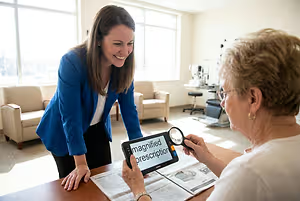
Depending on the tasks you want help with, options may include:
- Handheld or stand magnifiers for mail, labels, and food packaging
- Strong reading glasses for close work such as a book or a crossword
- Video magnifiers that enlarge text and let you adjust contrast and brightness
- Telescopic glasses for selected distance tasks, such as watching television
- Computer settings and screen tools that enlarge text or read it aloud
Each device has a job it does best. If reading is the main difficulty, start with low vision magnifiers. For distance tasks, telemicroscopes and E-Scoop glasses are worth trying, and you can read more about the full range on our low vision aids and devices page.
Most people end up with more than one device, because reading a bill and watching a grandchild’s game ask different things of your eyes. Lighting matters too, and a brighter lamp is sometimes the simplest fix of all. Our household tips for low vision patients cover the small changes that make a home easier to navigate.
Keep your retinal appointments as well. Depending on how your eyes are doing, your eye doctor may recommend injections, laser treatment, or surgery to protect the vision you have. Low vision care fits around that care rather than replacing it.
Your Low Vision Evaluation in Hartland
The visit begins with the tasks that have become difficult: the mail, a medication bottle, the stove, a phone screen, a face across the table. We check how you see at different distances and in different light, then you try devices in the office so you can judge what helps before you decide on anything.
You leave knowing which aids suit which tasks, how to use them, and what comes next. Some devices take practice, and we can talk that through with you.
Dr. Thomas R. Doud O.D. sees low vision patients at Low Vision Center of Michigan in Hartland, Michigan. Read more about our doctor and practice, or check our address, hours, and directions before you visit.
Schedule a Low Vision Evaluation
Tell us which tasks have become hard, whether that is reading your phone, following a recipe, or picking out faces at the dinner table. Low Vision Center of Michigan will assess your vision and walk you through the aids that may help.
If your sight has changed suddenly, call your eye doctor the same day rather than waiting for a low vision appointment.